
Deere John

This is Floyd. Hey, there’s a diner. Rick’s Wagon Wheel. It’s attached to the BP. There’s a Subway. On the other side of the highway. Fuck it. Let’s keep going.
This is Charles City. There are a few places to eat. And there’s even a movie theater. Doesn’t look open.
This is Waverly. Let’s walk downtown. See all the people bustling around from store to store? No? Me neither.
This is Janesville. Hey, there’s a park. By the river. They have a ball field. Isn’t that quaint?
This is Waterloo. I think it was 2012 when I saw the sign for the Waterloo Cattle Congress. George Jones would be performing.
“George Jones,” I said as Deb and I drove past the sign.
“Who?” she said.
“George Jones.”
“I don’t know who that is,” she said.
“He’s the best country singer that ever was,” I said. “I can’t believe he’s still performing. He’s going to be playing the Cattle Congress this summer. This might be our last chance.”
“Well,” she said. “We should go see him.”
But we didn’t. It was just another thing.
We pass through Waterloo, where once the John Deere factory was new. The twin, five-story buildings along the river where all the big bosses and engineers once lollygagged, plastic coated lanyards clipped to pockets of short-sleeved button-up shirts, along the wide waxy tile hallways on their way to or from the silent cafeteria, were abandoned twenty years ago. Part of the north building is now a John Deere museum. I don’t know what the rest of the space is being used for.
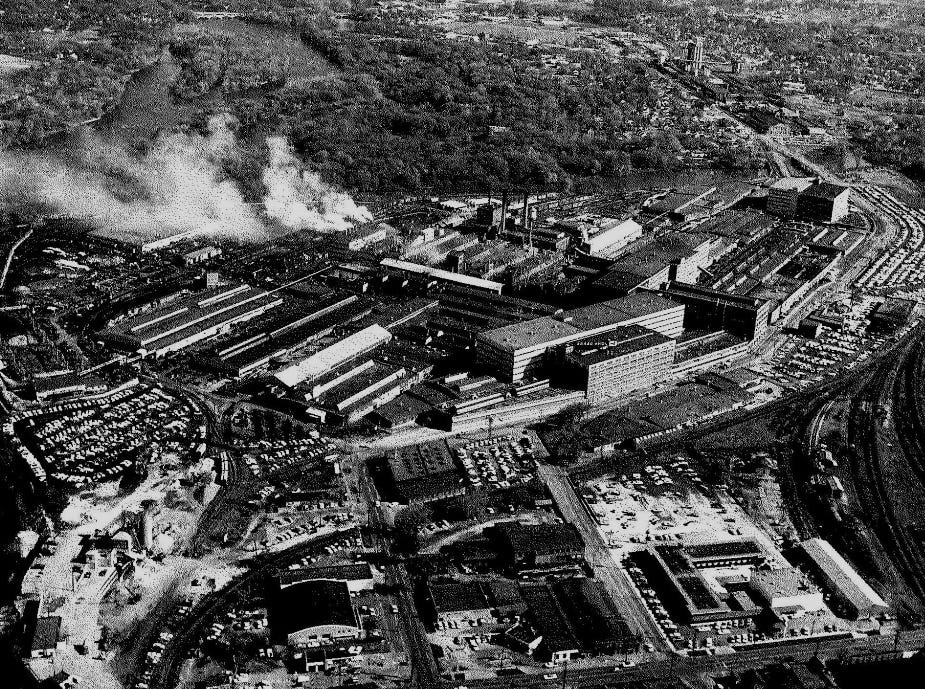
All around those two main buildings there used to be a shantytown where welders, plumbers, electricians, and carpenters hid out. I turned around an old Trane chiller that was housed in one of those cinderblock-walled, tin-ceilinged outbuildings. I was working with Lanny, an ex heroin addict who had followed the mother of his son to Iowa from central Florida, and Tiny, a 350-pound apprentice who would later be fired for involuntarily nodding off at work. The shantytown is long gone. Lanny died 20 years ago from complications related to hepatitis C and a renewed inclination toward drug use and alcohol abuse. Tiny found work as a long-haul truck driver. George Jones died the year after his big show at the Monroe County Fair.
I think of a place off Fletcher Avenue. What’s the name of that place? They had a special brand of expensive root beer everyone liked. So heavy, the straw floated up in the mug. Wouldn’t stay down. And that place was famous for something else too. What was it? Pork tenderloin, I think. Lanny, Tiny, and I would go there after work in the salt mines of John Deere. Tie one on.
I take the exit. Drive along Fletcher Ave.
“Where you going?” says Deb.
“I’m looking for a place,” I say. “A good place.”
I couldn’t see the place. “It must be gone,” I say. “They must have closed down. It was right there.”
But there is no place. Then I take a right so I can turn around in a parking lot. And there it is.
“Steamboat Gardens,” I say. “That’s it!”
The parking lot is empty. I pull up to the front door and squint at the sign.
“Closed Sundays,” I say.
But it’s still here. Same place. It looks just the same. Isn’t that funny?
I pull back onto 218. Over the bridge. Past the old John Deere headquarters. Past the Fighting Sullivan Brothers Museum. Past the Workforce place. Past the place that used to be the commercial tool outlet.
“There used to be a pizza place up here,” I say.
“Nick’s” says Deb.
“Yeah. Something like that. It looks like it would be good. Like a New England pizza place. You know? But it isn’t. It’s not good.”
We pass the place. Mama Nick’s Circle Pizzeria. Still there. Empty lot though. Maybe they’re closed on Sundays too.
“There used to be a Chinese place. Like Golden Palace or something. It sat there in the middle of the K-Mart parking lot. Like right in the middle of the parking lot. You could get lunch for five bucks. It included sweet and sour soup and tea and those crabmeat things and everything. Five bucks. And the food wasn’t bad, really. It was good.”
“You wrote an essay about that,” says Deb.
“Did I?”
“Yes. I remember it.”
“Yeah. That place is long gone.”
We end up stopping for Mexican at a place in a strip mall next to the place that used to be the auto parts store across from the place that used to be a scrapyard. I order a dinner plate of three enchiladas, rice, and beans. My meal, including the bottle of Mexican CocaCola costs me $15, exactly what my prickly pear margarita cost me at the Minneapolis bar the night before.
I wonder what would’ve happened to me if I tried to order a prickly pear margarita down at Steamboat Gardens. Back when we three — Lanny, Tiny, and I — actually believed in the repair of that old chiller. When we had to enlist that bedraggled, hungover welder to make it so the rusty cast iron impeller flange was divot free. He built that thing up with welding rod and turned it down so it was absolutely and perfectly smooth. It accepted that neoprene o-ring just the way you want. New o-rings on that machine. New bearings. That old centrifugal spun like a top. No vibration. New labyrinth seal. Good oil pressure. Good suction cooling. We thought that chiller would run for another thirty years. And why wouldn’t it? And, by the way, even though all those shantytown buildings are gone now, who’s to say it wasn’t important, what we all did back then?
Nobody. That’s who. There’s nobody to say.
Good one. "Used to be." The way we describe the past now.
My favorite is when it's in verbal directions: "Go past where
the pizza place used to be, turn onto that new road that used
to be gravel, then go past the old Miller place. If you lose
phone reception, you went too far."
Kicker of a last line.