
Shuttle

I’ve wanted to use this angle for quite some time, the mechanic who feels the need to repair his broken relationships, but I can’t use it. Because I don’t feel the need to repair anything. In fact, the places that comfort me most in the world are places of ruin, where walls crumble and cast iron drain pipes stand broken and puddled with groundwater. And the more grand the original construction — and therefore the more momentous the eventual abandonment and dilapidation — the better.
I grew up just outside Lowell, Massachusetts, the epicenter of the great American industrial revolution. What was left over by 1980, the year I graduated Westford Academy, were dozens of ruined textile factories, abandoned canals, rusted locks, disintegrating mortar, crooked bricks, broken windows, and oil stained pine floorboards, places where the ghosts of farm girls lost their youth, their lives shuttling back and forth and gone. Downstream. Flotsaming and jetsaming in that black water of the Merrimack River. To the deep Atlantic.
Very poetic. No?
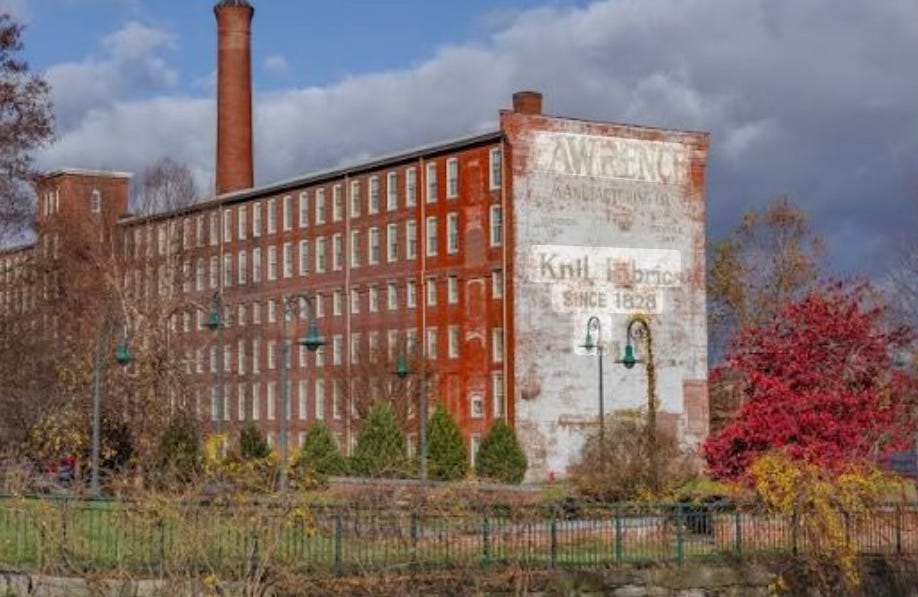
I don’t want to repair anything.
Last night, I overheard Deb and our daughter-in-law, Amber, conversing about the TV show, The Pit. Deb said something like, “You know that guy? The lead guy? Noah Wyle?”
Amber — I think he’s hot.
Deb — You know he was, like, an intern in another show, ER? He was the kid.
Amber — He’s hot.
Deb — And the whole idea of the series was to take that character and move him to the present day. The same character. But the original producers or whatever? They wanted a billion dollars or whatever for the right to do that. So they just made it a different character.
Amber — You know he wrote the screenplay? He wrote it.
Deb — But what I’m saying is, the show was supposed to be about his character on ER.
Amber — And he wrote the show.
Deb — He was the intern. The kid. And now he’s—
Amber — Yeah. All I’m saying is—
Deb — I still think of him as that same character anyway.
I could jump in. But why? I’m not a mechanic. And this isn’t my machine to repair. The only machine I can try to repair is mine. So. I go to the menu screen. I select service. Then diagnostics. Then inputs.
Am I included in this conversation? Am I hearing correctly? If I believe I’m hearing correctly, am I actually listening? Further, am I incorporating what I have received into my consideration of the topic at hand? Then I select outputs.
Can I say something relevant? Can I say something kind? Can I say something I believe to be true? Or am I kidding. Are the people I’ll be conversing with kidding? Are we all on the same page? And even if we think we’re kidding, are we really? What did my interlocutors say, exactly? What did they mean? How do they feel about themselves? How do they feel about me? What do they want? What can I give them?
Better to keep it shut.
Deb and I took my mother out to dinner a few nights ago at Reunion, a nice place on the Coralville strip. While waiting for our orders, I pulled up a photograph of one of my brother’s oil painting on my phone and showed it to my mother.
“Oh,” she said. “Who did he paint this for?”
“Who did he paint it for?”
“Who is it for?”
“I don’t know what you mean,” I said. “He painted it. Like, this week.”
Mom — Oh. He painted it.
Me — Yes.
Mom — He just painted it…for himself?
Me — For himself? No. I don’t know. He just painted it. For everyone.
Mom — Everyone?
Me — Yeah.
Mom — David has never known how to market himself. I keep telling him, he needs to do something he can sell for ten dollars. Little things he can do quickly. That way, when he’s in his booth, people will stop and buy the little things.
Me — His booth?
Mom — His what?
Me — His booth?
Mom — His boot?
Me — BOOTH. BOOTH. You said his BOOTH.
Mom — Oh. His booth. At the, you know, art shows.
Me — You mean, like, craft fairs? I’ve never seen much art at those things.
Mom — That’s how you sell it. That’s how you sell it. Your brother needs, I keep telling him this, to paint things. Small things. He can do fast. And sell for ten dollars each. That way…
Me — I don’t know if that’s how an artist’s mind works. I don’t think he’s thinking about little things he can do quickly so he can sell them for ten bucks.
Mom — Yes. That’s exactly what I keep telling him. He doesn’t know how to market himself. And, you know, you aren’t an artist if you don’t sell anything.
Me — Van Gogh never sold anything. His whole life. Except to his brother.
Mom — What?
Me — I don’t think you need to sell anything to be an artist.
Mom — That’s what I’m saying. If you’d listen. If nobody pays for your work, you can’t say you’re an artist. You’re just doing it for yourself.
Me — That’s silly.
Mom — It’s what?
Me — SILLY. That seems like a ridiculous thing to…
Mom — That’s what I’m saying. If nobody says you’re an artist, and pays you, you can’t say you’re an artist. Me? I wrote poetry for years. And you know what? I never sent any of it out. None of it.
Me — And you think that’s a good thing?
Mom — My what?
Me — And that’s good? You’re happy about that? You think that’s a good thing?
Mom — Well. I wasn’t a poet.
Deb — If you write poetry, you’re a poet.
Mom — No.
Deb — Yes. That’s what I think.
Me — I agree.
Mom — Oh. No. No. I…no.
Lowell factories constructed during boom times. Waterloo factories. Burlington factories. Now long abandoned. Settling in repose on their uneven footings. Sheathing rotting amid collapsing rafters. Red tiles missing. I love those old places. From a distance. It’s only when I sort through their ruins. And consider repair. That I know I need to let them go. Return home.
I’m not a mechanic. Not at heart. I’m not inclined toward repair. What I want to do is listen to old music. Written and performed by people long dead. That’s the easy, honey-colored path I chose. To appreciate bygone beauty. Antique constructions. While longing for the collapse of this new Rome.
Again. I need to cut the shit. I’m trying pretty hard to be poetic.
You’d think that now would be the time to end this stream of thought. It would be the easy thing to do. Like walking out on a discussion gone wrong. But this isn’t the end. It’s just beginning now. This is where I try again. Go back inside. Find something useful to do. Try again. Go back. This lyric sorrow. These glittery goodbyes. They don’t do anyone any good. You need to do something. You need to give something to someone. Serve someone, as Dylan said. Start over. Not the same character anymore. Far from it. But still. That’s how I think of myself. You know I wrote the script? Anyway…
One of my favorites. I urge you write more. Then your brother can illustrate them. And you can sell them for ten bucks at abandoned factories.
I think you and Noah Wyle are both hot.
I got to admit-I’ve caught myself looking at craft fair booths and farmers markets and art fairs thinking “Who would ever buy this stuff…”
A terrible perspective but it’s drilled into us.